wherefore
Particula forensis
Description
A compound interrogative of the where- lineage, asking after causes: wherefore means for what reason, and a sentence containing it is a request for an explanation, not a location. The organism is large for a Particula — two full syllables, front-loaded with stress — and was in its breeding centuries among the most direct instruments English had for demanding that someone account for themselves.
It is documented here for a distinction no other organism in this guide yet holds: it is best known from a sighting in which it is misidentified. The most famous wherefore in the language is almost universally read as a where, a circumstance treated at length under Easily Confused With and one the Society records without satisfaction, since the error is made by readers and the organism is in no position to correct them.
Status
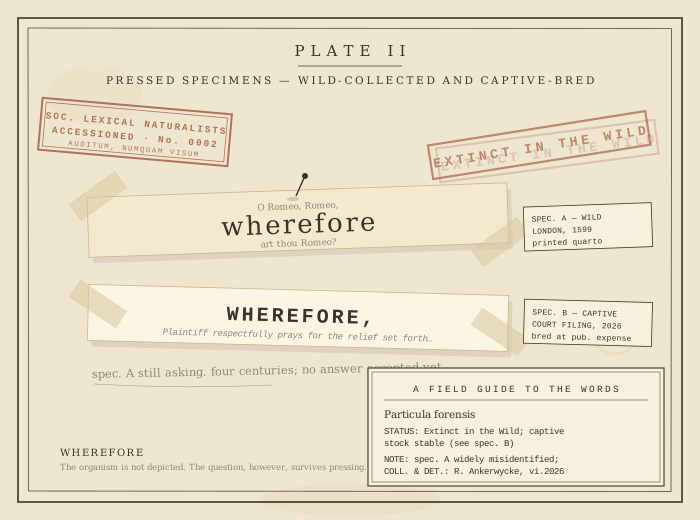
Extinct in the Wild. No breeding population has been recorded in unrehearsed speech or unselfconscious prose for well over a century. The species survives in three captive populations: (1) the legal pleading, where it heads the prayer for relief and is maintained at public expense; (2) the fossil noun in the fixed phrase the whys and wherefores, where it persists by having stopped being an interrogative at all; (3) a single line of Elizabethan drama, restocked nightly by the world’s repertory theatres. The Society had hoped this entry would be the guide’s first pressing of a fully Extinct species. It reports with some care that it is not — the captive stock is genuinely alive — and refers the reader to the official vocabulary, which exists for exactly this discipline.
Range
Formerly bred throughout English speech and prose; the 1611 Authorized Version alone contains dozens of breeding records (wherefore didst thou doubt?), indicating a population then near saturation. Contraction was rapid through the eighteenth and nineteenth centuries and total by the twentieth.
Current captive range: court filings, where it appears at the head of the concluding paragraph, customarily in full capitals; contracts drafted by firms that bill by the hour; the theatre; and the noun preserve noted under Status. Strays occur in historical fiction and in the speech of persons who have recently left a production of Romeo and Juliet.
Call
Two syllables, trochaic, stress on the first: WHERE-fore. In its captive legal habitat the call is rendered entirely in capitals — WHEREFORE, Plaintiff respectfully prays — which the Society interprets as display rather than volume, the organism having no competitors left to shout over. On stage the call is produced with the stress migrated unnaturally toward the second syllable by actors signalling that the word is old, a distortion not found in any historical recording and best regarded as an artefact of captivity.
Sign
A text the organism has passed through will show: (1) archaic verbal plumage in the immediate vicinity — didst, hast, art — since wherefore has not travelled with modern conjugations in living memory; (2) in legal habitat, a following comma and a verb of petition (prays, requests, demands); (3) an answer, somewhere in the following lines, that begins with because. This last is the surest sign and the basis of the field test given below.
Easily Confused With
Where. This is the field mark, and the confusion is not hypothetical: it is the dominant reading of the most famous sentence the species appears in. O Romeo, Romeo, wherefore art thou Romeo? asks why he is Romeo — why, of all the names in Verona, the one her family is at war with — and is answered two lines later by an argument about names. It does not ask where he is. He is beneath the balcony.
The field test is the shape of the answer. A wherefore takes an answer beginning with because; a where takes an answer beginning with a preposition. Productions in which Juliet delivers the line while visibly searching the garden have documented a where; no wherefore was present.
The Society notes the resulting condition of the species without parallel in this guide: an organism extinct in the wild, surviving chiefly in a single preserved utterance, and famous in that utterance for being mistaken for its commonest living relative. The relative, for its part, has never acknowledged the resemblance.
Breeding & Hybridization
Wherefore belongs to a once-productive breeding population of where- compounds: whereby, wherein, whereof, whereupon, whereas, wherewith and its derivative wherewithal. The lineage bred by simple suffixion and at its peak could attach where- to nearly any preposition in reach.
The siblings’ fates are instructive. Those that survived did so by one of two strategies: taking salaried positions in legal and contractual habitat (whereas, which now opens recitals and does little else), or abandoning the interrogative life entirely and going noun (wherewithal; wherefore itself, in the plural, in the whys and wherefores). No member of the lineage survived in the wild on its original diet.
Continental cousins remain abundant — Dutch waarvoor, German wofür — and breed freely in everyday speech, a circumstance the Society offers to any reader inclined to believe the extinction was inevitable.
History of Classification
A Middle English compound of hwǣr and for, assembled during the period when English built its question-words the way it built its barns, from materials on hand. Its decline is attributed not to habitat loss but to direct competition: the native why, occupying an identical niche at half the metabolic cost, outcompeted it in every register informal enough to care about effort. The pattern — a two-syllable specialist displaced by a one-syllable generalist — recurs throughout the historical record and the Society expects to document it again.
The binomial assigns the species to its surviving habitat (forensis, of the forum). A proposal regarding the epithet is lodged in the Marginalia.