overmorrow
Vocabulum desuetudinis
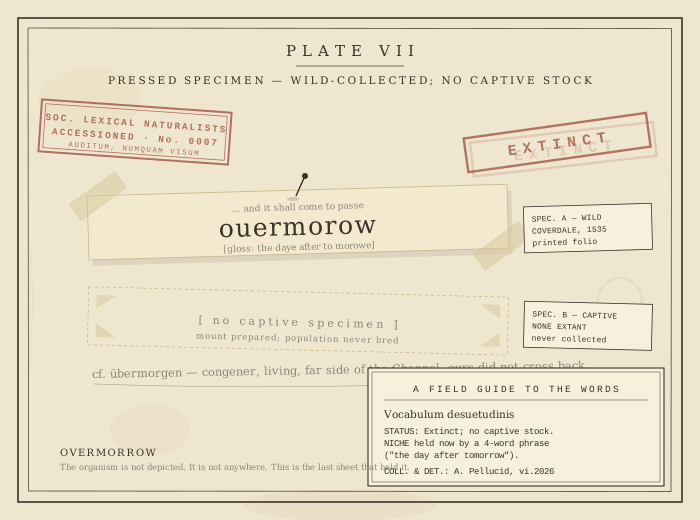
Description
A temporal organism of the genus Vocabulum, denoting a single fixed point in the near future: the day after tomorrow. The organism is a compound, over- (beyond) joined to morrow (the coming day), and it names its referent in one stroke the way tomorrow names the day before it — by pointing, not by counting. It functioned chiefly as a noun (“till the overmorrow”) and as an adverb of time (“we sail overmorrow”), occupying exactly the slot one rank further out than tomorrow and exactly one rank nearer than the unnamed day beyond.
It is the only organism yet collected by the Society that the reader may attempt to use and find absent from the mouth. This is the defining behavior of the species and the reason for its status: it does not survive in the living speaker. What survives is the slot it once filled, now empty, and the four-word phrase that has filled the slot without filling the word.
Status
Extinct. The diagnosis is not rarity but a broken line of descent. A word is Extinct, as distinct from Extinct in the Wild, when no continuous population of native users remains and the organism survives only as a preserved specimen. Overmorrow meets the test exactly. It is recorded in dictionaries under the markings archaic and obsolete; it recurs, reliably, in published lists of charming words that ought to be revived. Neither is survival. A dictionary entry is a pressed cutting, not a living plant, and every modern appearance of the word is a fresh re-collection from that cutting rather than an inheritance from a speaker who had it from a speaker who had it. The lineage does not run; it is repeatedly restarted from the fossil. That is what extinction looks like in a word: not silence, but a population that can only be cloned and never bred.
The Society notes, without revising the status, that the organism is in no danger of being forgotten. It is in danger of nothing. The dead are secure.
Range
Historical wild range: Early Modern English broadly, with a documented population in sixteenth-century printed translation — the organism appears in Coverdale’s 1535 rendering of the Bible, where it was put to work calquing the living German übermorgen, and in regional dialect speech that retained it for some generations after the standard register had let it go. The last wild populations were rural and northern and are not precisely dated, dialect death rarely being witnessed.
Current range: the preserved collections only. It breeds nowhere. It is found in the obsolete strata of large dictionaries; in word-of-the-day features; in the recurring listicle of forgotten words we should bring back, which is the species’ principal modern habitat and is, taxonomically, a museum rather than a meadow. It strays, briefly, into the prose of writers who have just encountered it and wish to be seen having encountered it, almost always wearing the parenthetical gloss that marks a reintroduction. Across the Channel its congeners are not rare at all: German übermorgen, Dutch overmorgen, and their relatives hold the niche in robust health. The English population is the one that died. The genus did not.
Call
Reconstructed, of necessity, from preserved material: three syllables, primary stress on the first, /ˈoʊvərˌmɒroʊ/ — OH-ver-morr-oh — the same contour as tomorrow with a syllable prefixed and the stress dragged forward to the front. No field recording of the wild call exists, for the sufficient reason that no living speaker produces it natively. Every recording in hand is captive phonology: a modern speaker reading the word off the page for the first time, and the prosody of a word read off the page for the first time is not the prosody of a word that lives in a mouth. The wild call is therefore inferred, not heard, and the Society marks the inference as such. We have the spelling. We are guessing at the music.
Sign
A modern text that has passed through overmorrow is detectable at a glance, because the organism almost never travels now without its collar. The reintroduced specimen arrives glossed — “overmorrow (that is, the day after tomorrow)” — the parenthesis functioning exactly as the radio tag on a released animal: proof that the creature is not native to the habitat it has just been let into, and that someone is keeping track of it. Where the gloss is absent, a second sign appears in its place: a small seam of self-consciousness in the surrounding sentence, the faint braced posture of a writer using a word they expect to be admired for knowing. The organism leaves, in either case, a wake of charm. This is itself diagnostic. Living function words leave no wake; only the exhumed ones glitter.
Easily Confused With
“the day after tomorrow.” This is the field mark, and it is one nearly every English speaker has felt without naming. The common intuition is that English simply lacks a single word for this day — that the language draws a blank one step past tomorrow and is reduced to counting, the way it is genuinely reduced to counting for the day beyond (there is no native single word for that one). The intuition is wrong, and the error is the entry’s heart: English did not lack the word. English had the word and lost it. The four-word phrase is not the patient filling of an ancient gap; it is the invasive species that moved into a cleared niche after the native was gone. Distinguishing the two is distinguishing an absence from a death — a slot that was never filled from a slot whose occupant was outcompeted by a phrase that is clumsier, longer, and slower to say, and that won anyway. Why the worse competitor won is the open question; that it won is the confusion to correct. A reader who learns this stops feeling that English forgot to make the word and starts feeling that English forgot the word it made, which is a different and sharper feeling, and the correct one.
“ereyesterday” (also ereyester). The organism’s mirror twin, pointing backward where overmorrow points forward: the day before yesterday. The confusion is one of symmetry — a speaker who recovers overmorrow often assumes its reflection must still be living, since the need for it is just as real. It is not. Ereyesterday is equally Extinct, by the same mechanism and on roughly the same timetable, and the two should be filed as a sympatric pair that went out together: the language did not lose its word for the near future and keep its word for the near past, or the reverse. It released its grip on both fixed points at once and now reaches each of them, when it must, by counting outward from today. The pair is the cleaner specimen of the phenomenon than either twin alone.
“tomorrow.” Not a true confusion of meaning — no competent speaker mistakes the day after for the next day — but a confusion of fate, and the instructive one. Tomorrow is built identically (to- + morrow), names its day by the identical pointing strategy, and is among the most Abundant organisms in the language. The two are siblings; one is everywhere and one is dead. The difference is not in the word but in the day. Tomorrow names the future the speaker is always already planning for, the future that presses on the present; overmorrow names the future just past the edge of that pressure, the day we are rarely yet thinking about hard enough to need a fast word for. The organism did not die of any flaw in its construction. It died of the position of its referent: too far out to be urgent, too near to be ignored, and so handed to a phrase, because a phrase is what we use for the things we can afford to say slowly.
Breeding & Hybridization
The compounding strategy that produced the organism (over- applied to a unit of time) is itself extinct as a productive process in this corner of the lexicon; English no longer breeds new day-names this way and has not for a long while. The strategy remains vigorously productive in the cousin languages, where über- and over- still freely make new temporal compounds, which is part of why the congeners abroad are healthy while the native is not — the breeding behavior emigrated with the surviving stock. Within English, the only modern “offspring” of overmorrow are the revivals, and revivals are not offspring. They are the same dead specimen handled by successive admirers, warm for as long as the hand is on it.
History of Classification
The lineage is Germanic and clean: over- from Old English ofer (beyond, above), morrow from Middle English morwe, from Old English morgen (morning, hence the morning to come, hence the coming day) — the same morgen that lives, unretired, in German übermorgen. The organism is therefore not an oddity but a regular formation that simply failed to survive in one of the several languages that built it. It carries no vestigial organs, no silent letters, no surgeon’s marks; it is structurally sound throughout, which makes its extinction the more pointed. Words with deformities have an alibi for dying. This one had none. It was well made, useful, and pronounceable, and the language set it down anyway, in favor of four syllables more. The History of Classification records, for once, a death with no cause of death — only a date of last sighting and a healthy corpse.