actually
Particula correctionis-obliquae
Description
A small function word that operates primarily on discourse rather than on manner. The organism does not describe how an action occurs; it repositions the hearer’s understanding of what has been said. It delivers correction by occupying the space where truth is assumed to live, allowing the hearer to notice their error by its absence. The particle maintains the posture of transparency—claiming only to state what is factual—while performing a social maneuver: the oblique correction, angled rather than direct. “Actually, the meeting is at three” does not say “you are wrong”; it says “let me quietly occupy the space where the truth lives, and you will notice your error by its absence.”
Status
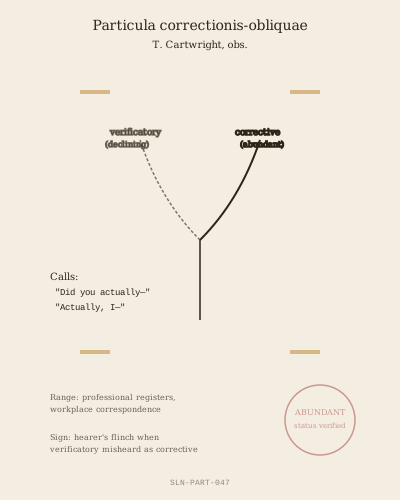
Abundant. The population has expanded slowly, broadly, and sustainably over three decades, particularly in professional and academic registers. No concern; possibly too little concern. The organism pervades rather than explodes.
Range
Spoken and written professional registers; workplace correspondence; email. Breeds freely in contexts requiring status negotiation between speakers. Strays occasionally into casual speech but shows strongest establishment in institutional and academic domains where soft correction carries social advantage.
Call
Utterance-initial, typically preceding a clause that contradicts or reframes an interlocutor’s assumption. Stress pattern: unstressed or lightly stressed, often elided in rapid speech to “'ctually.” Prosodically, the particle announces incoming repositioning; the hearer learns to brace for displacement. Two distinct call-types exist in the wild, indistinguishable in form but opposite in function (see Easily Confused With).
Sign
The half-second flinch in the hearer when a sincere question—“did you actually finish?”—is received as soft accusation. The organism leaves no visible track; its presence is known by the hearer’s defensive posture, the slight recoil that signals the brain has sorted the incoming particle as corrective rather than verificatory. In written correspondence, the sign is the recipient’s delayed response, the careful re-reading of their own statement to locate the error they are now certain they made. The abundant corrective morph has trained the population’s ear; when the rare verificatory morph appears, it is misheard as predatory.
Easily Confused With
The verificatory morph of its own species. Actually exists in two behavioral morphs, indistinguishable in plumage:
The verificatory morph (declining): “Did you actually read it?” — a sincere request for confirmation, where actually retains its etymological function as a marker of actuality, of what-was-in-fact-done. This morph is Vulnerable; it appears in the wild with decreasing frequency.
The corrective morph (abundant): “Actually, I read it yesterday” — where the particle signals incoming correction of an assumption, with no reference to factuality and full cargo of social repositioning. This morph is Abundant and expanding.
The two cannot be reliably distinguished by context. Both thrive in professional correspondence; both appear in identical syntactic positions; both may occur in the same conversation, sometimes in consecutive utterances. The hearer must decide in the half-second after the word lands which animal has just entered the clearing: the truth-seeker or the soft-status-claimer. The abundant morph is now predating the rare one in the ear of the population. When the verificatory actually appears, it is increasingly misread as corrective because the corrective use has become the dominant call. The sincere question arrives and the hearer flinches, hearing accusation where verification was meant.
Breeding & Hybridization
The particle breeds readily with clauses of contradiction or reframing. Productive combinations include actually, I (corrective assertion), did you actually (verificatory question), actually, the (corrective fact-replacement). Hybrids with literally exist but are distinct organisms; both are drained intensifiers, but actually performs social repositioning while literally performs semantic intensification. The two should not be confused despite occupying adjacent ecological niches.
History of Classification
From Latin actualis (of or pertaining to acts or deeds), the particle originally marked factuality—what was in fact done, as opposed to what was supposed or intended. The verificatory morph preserves this etymological function. The corrective morph represents a semantic drift toward social function: the particle now marks not factuality but the speaker’s claim to occupy the space where factuality lives. This drift is not decay but adaptive radiation. The organism has not lost its original meaning; it has acquired a new behavior while retaining the old form, creating two morphs from one stem.
Disputed Sightings
Unverified. The Society does not endorse.